Shock and deterioration
You can click the image to enlarge it.
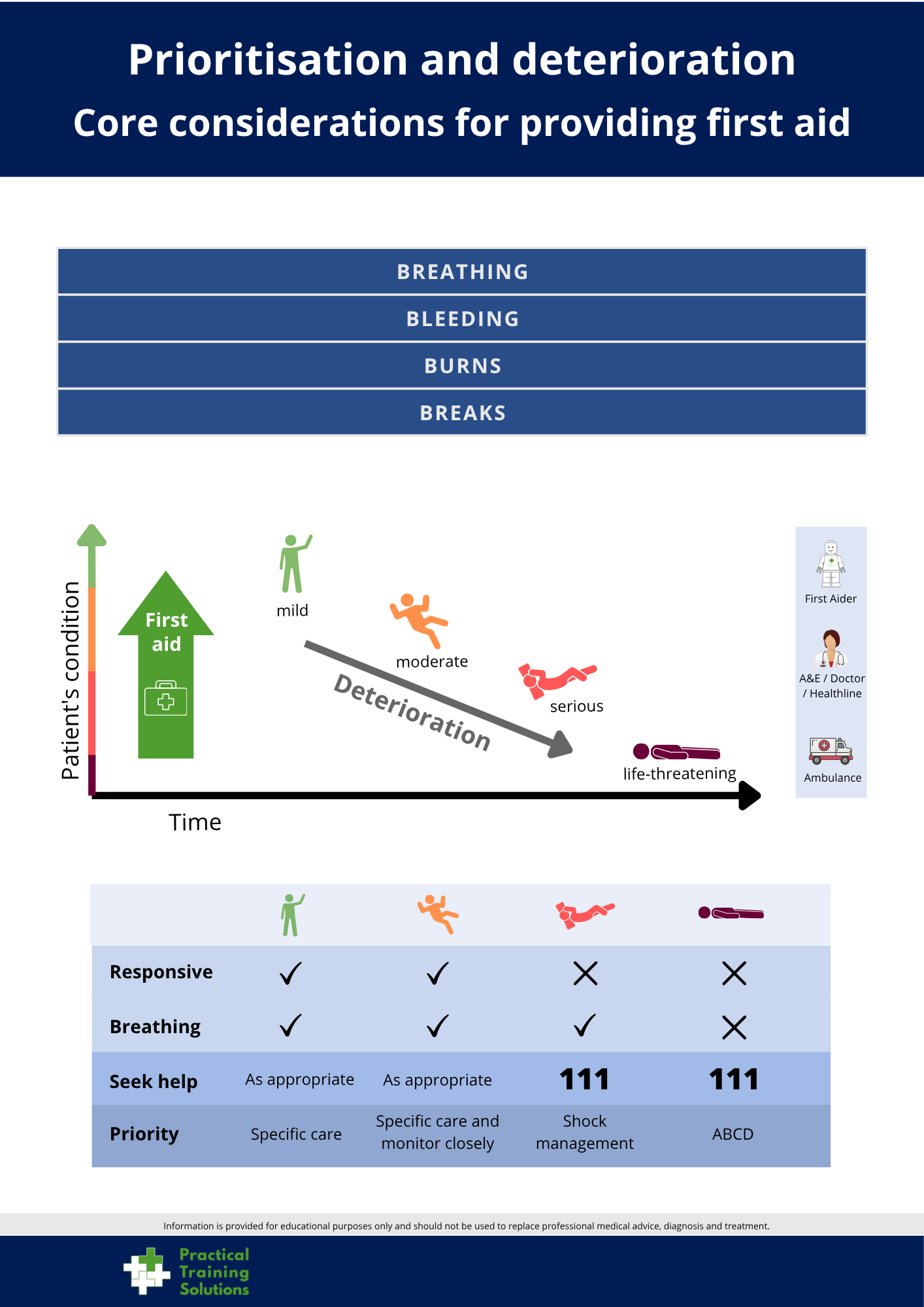
Deterioration and shock are closely linked in first aid. Our prioritisation and deterioration illustration, which you will be very familiar with, shows how a person can move from mild illness or injury through moderate and serious stages to life‑threatening deterioration over time. Shock is one of the key reasons this deterioration happens, because the circulation is failing and vital organs are not getting enough oxygen.
For first aiders it is important to recognise when someone is seriously ill or when someone is deteriorating. That is why we need to focus on patterns of change over time rather than just on one single sign or signs at a single point in time.
Our illustration helps you and your learners picture this. A person might start in the “mild” zone – talking normally, breathing comfortably, skin colour normal – but if their breathing becomes faster, their skin turns pale and cool, they feel faint or confused, or they stop responding as well, they are sliding down the deterioration slope towards serious or life‑threatening illness. While they are deteriorating it is likely they are also “going into shock”. Shock is a common pattern in the serious end of the spectrum, and the same simple first aid actions you use for the seriously ill person – lying them down, calling 111, keeping them warm, managing breathing and bleeding, and reassuring them – are also the core of shock management.
Listen to the text above:
Your role as a trainer is to keep referring to the prioritisation and deterioration illustration throughout the course. You have the illustration on a banner or wall poster and learners also have it in their Quick Reference Guide. Make sure you keep emphasising the patterns of deterioration and shock throughout the practical session. For shock that means you don’t just cover it during the specific shock section of the session but reinforce it in relation to injuries and medical emergencies.
It is also important to remember that deterioration can be subtle at first and that children and infants can worsen very quickly. Using the illustration, you can explain to learners that their job is to notice when someone is moving along that line towards greater risk, then step in early: monitor closely in the mild and moderate stages, seek help and start shock management as the signs add up, and call an ambulance without delay when the person becomes seriously unwell or unresponsive.
Listen to the text above:
– Deterioration and shock are closely linked in first aid.
– Our prioritisation and deterioration illustration shows how a person can move from mild, to moderate, to serious, to life‑threatening over time.
– Shock is a key reason people deteriorate, because the circulation is failing and vital organs are not getting enough oxygen.
– Don’t just look at one sign or signs at one point in time – watch for patterns of change over time to recognise deterioration and serious illness.
– Someone who starts off mild but develops fast breathing, pale cool skin, confusion, or reduced response is sliding down the deterioration slope and may be going into shock.
– The simple actions for the seriously ill person – lie them down, call 111, keep them warm, manage breathing and bleeding, and reassure them – are also the core of shock management.
– Deterioration can be subtle at first, and children and infants can worsen very quickly, so learners need to notice movement along the line and act early.
Listen to the soundbites: